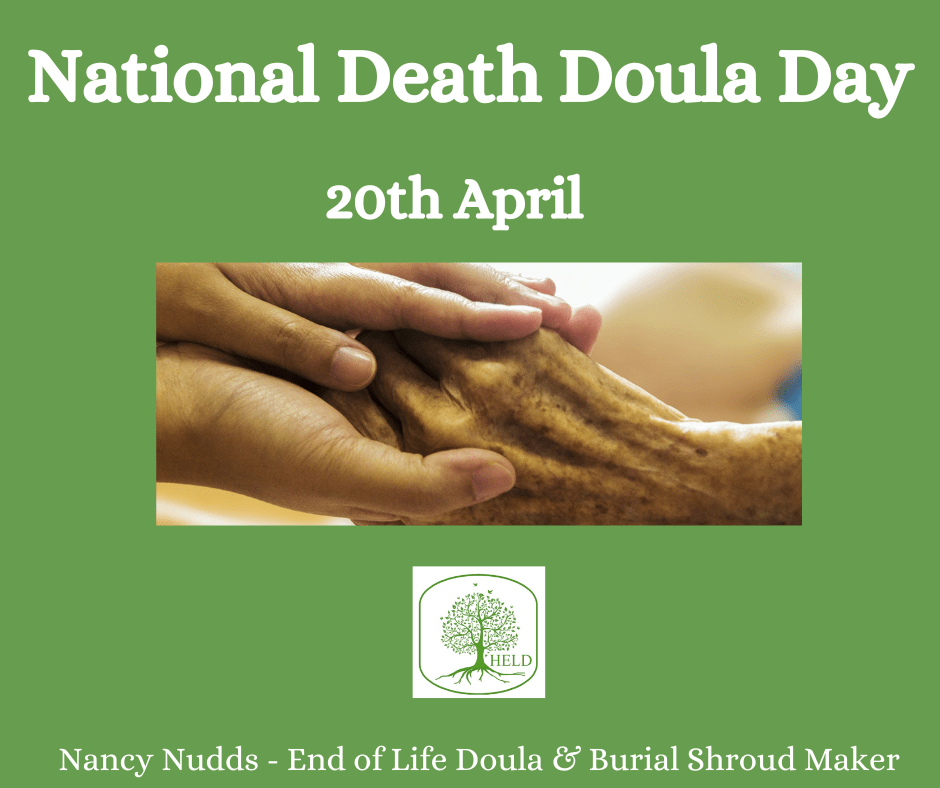
National Death Doula Day

20th April is National Death Doula Day!

Encompassing the End of Life Doula, the Soul Doula, Soul Midwives and Deathwalkers.

So, you want to be an End of Life Doula?

I sometimes get emails from people interested in offering this service so what does it take to be one?

Well, let’s first begin by telling you that if you’re looking for an occupation that will make you financially rich or even financially comfortable then this isn’t for you.

It will, however, bring a richness to your heart and life that is priceless.

If you need an income appreciate that you will have other work running alongside being an End of Life Doula.

As a Doula you will be invited into life’s most profound, intense and humbling experiences.

Do you need to have experience in end of life care before training?

Not at all.

What’s most important is your propensity, willingness and ability to love, to hold space and listen deeply. Humility is absolutely essential in supporting the dying – we can’t and will never know it all because each and every one of you are unique.
Can you advocate for others sometimes in the face of opposition?

Are you resourceful? It really isn’t as simple as sitting at the bedside and holding a hand.

Can you trust the dying process and can you trust that your companion knows what is right for them?

Can you remain grounded and present when grief, suffering and overwhelm shares the same space?

Can you lean into that suffering?

Be absolutely present with it?

Are you resourceful? It’s not a matter of tending passively but digging into your resourcefulness when needs arise.

I strongly recommend that you DO gain some experience in being present with the dying either through working/volunteering in a care home or hospice. Caring for someone who is a relative or friend is very different to companioning a family that you don’t know at the end of life. Although, indeed, they will feel like family very quickly.

Some people come to this field who already work in healthcare such as doctors, nurses, social workers and healthcare assistants and some work in the holistic services but equally there are many from other areas of work who simply feel called to this.

Be prepared for the training to be deeply reflective.

A place where you will likely touch your own grief and suffering.

Be prepared for the practice of doula-ing – the practice of deep listening, holding space, humility, presence and tender loving to be ongoing. They are not skills that we reach the pinnacle of and stop but ones that require us to consciously practice. We are human and whilst practicing these skills we get to recognise where we could do better.

And be prepared for the dying to reveal to you that they are the biggest wisdom holders of all time.

Not always in their words but in their presence.

Is this your calling?

With love

Nancy xx

The Signs of Active Dying

It’s time for a refresher on what active dying is and what it might look like.

Caring for someone at the end of life or facing end of life yourself can be a pretty daunting experience made more so when we don’t know what to expect.

And, to be fair, there’s is a lot about end of life that we don’t know.

But when we can familiarise ourselves with what we do know it can really help to alleviate some of that fear, concern or stress.

The active phase of dying is the final stage of the natural process of bodily functions slowing down and/or ceasing. It’s important to understand what to expect and to learn the signs of active dying, but it’s also important to keep in mind that predicting when death will occur is still difficult.

It will happen anywhere between 2 weeks to just a few hours before death.

Keep in mind that everyone is different and don’t always exhibit all the signs.

So, here are some of the physical AND non-physical signs you might expect when someone is actively dying.

Breathing – will slow and, if you are fully present, you will notice that their breathing becomes irregular. Sometimes there’s rapid breathing before it starts to slow. There will be little spaces between each breath and these spaces will get longer and longer. You will be wondering, each time, if this is the last one. Breathing also becomes shallower. You may notice what looks like a gasping for air – this is natural and nothing to be concerned about and the person knows nothing about it. You may notice a rattling sound on the breath and in the throat which can be quite scary or uncomfortable to hear but it’s a perfectly normal part of the process and doesn’t usually cause discomfort to the person dying. More discomfort for the people listening to it! This is sometimes know as the death rattle. It might help to position your person on to their side to aid in the draining of any fluids if it is triggering coughing or choking episodes. All of these changes are natural and expected and is not thought to cause suffering.

Skin can become blotchy – the blotches pink or bluish in colour. The extremities such as the feet and hands might take on a bluish tinge. Their body might feel cooler but it might also feel very warm to the touch. If you suspect a temperature you can try to make your loved one comfortable by doing all the things you would usually do such as a cool flannel or removing layers of bedding. The important thing is to keep your person as comfortable as possible.

Eating and drinking – your person’s hunger will diminish. This is all perfectly normal so try not to force or encourage your person to eat – honestly, it won’t make them live longer but it may cause extreme discomfort as their body is shutting down and they are excreting less. The natural process of stopping eating and drinking sends their body into ketosis which makes them feel good and diminishes their urge to eat or drink.

Bowels/bladder – linked to eating and drinking. As the body shuts down that includes ALL bodily functions so you may notice them passing less (or no) urine and faecal matter. In laymen’s terms peeing and pooing will stop.

Speech – your person may talk about getting their bag ready, finding their passport or tickets. Sometimes this can happen even before the active dying phase too so don’t be surprised or concerned. Just know they are getting ready for the transition.

Muscles – the mouth and eyes will be partially open. Sometimes the mouth hangs wide open. This is because the muscles are fully relaxed. Do you know it takes muscles conscious effort to close your eyes and mouth?

Reaching – you may notice your person reaching out with their arms. This is quite a common phenomenon and is one of the mysteries of the process.

Visioning – this is another mysterious phenomenon. It is where the person dying sees people or things that we don’t. Sometimes it’s dead relatives or friends and sometimes it’s people they don’t recognise. They may tell you that a spouse, parent, grandparent, a dog, sibling is standing in the room, sometimes in the doorway. It usually isn’t unsettling for them but often provides a sense of reassurance. Wouldn’t it be lovely if we knew someone special was waiting to guide us into whatever comes next?

Wakefulness/sleepiness – your person will spend increasing amounts of time sleeping. Only waking for brief periods until they lapse into unconsciousness.

Your person will become less responsive.

Until their last breath is taken you won’t know it was their last breath.

But it does come.

The heartbeat ceases.

But don’t rush off anywhere.

Take your time to be with them for a little while longer.

There is no hurry.

Linger – I love this word.

Linger until you are ready to leave their side.

As much as we wish it not to be so there is an amazing transformation happening during the active dying phase.

Ultimately, trust that the body knows exactly what it is doing. It knows how to shut down. It knows how to die. Our bodies are amazing!

And just a reminder – your person or you may not experience all of these signs or any. Everyone is different and it doesn’t mean anything is wrong.

Photo by Damien Wright on Pexels.com

With much love

Nancy xx

Eating and Drinking at End of Life

I’ve written about eating and drinking at the end of life and what that can look like before.

Here’s a recap – your person’s hunger will diminish. This is all perfectly normal so try not to force or encourage your loved one to eat – honestly, it won’t make them live longer but it may cause extreme discomfort as their body is shutting down and they are excreting less.

But….

What do you do when your person is dying and their appetite has diminished but they are still insisting on eating something despite the pain and discomfort it causes them afterwards?

Perhaps we should first acknowledge that dying isn’t always what it looks like in the movies – unconscious, unresponsive, blissful.

It can be.

But there are usually other things going on behind the physical and medical scene.

Sometimes, a person dying can be conscious and aware up until very close to death.

There will be other signs that the dying process has begun and yet, your person feels that they “should” eat something.

And this can be despite them being very aware that death is fast approaching.

This scenario can be complex but ultimately it is the choice of that individual to eat (if they have capacity to make that decision) even when they know it causes extreme pain afterwards. Towards the end there is so little that can be within a persons control and eating might be the one thing that they can.

And enjoy the taste and the ability to eat in the process.

For those of us supporting someone in that situation we can gently let them know that the pain is likely due to eating when their body is trying to shut down. Remember the body knows how to die and it does so regardless of eating or drinking. Having honest conversations can be empowering for the other person.

Equally, your person might not be willing to have that conversation or open to hearing that. Or, might weigh up the situation having had the conversation and decide to eat anyway. And that’s ok.

So, don’t make it into a battle or deprive your person of food.

Instead, find some common ground.

Offer relief in the form of medications – paracetamol, wind relief tablets etc.

Or try repositioning them to see if that will ease their pain or discomfort.

Give them agency over their own body if they are able to make the informed choice to eat.

After all, it won’t be for much longer.

Nancy xx

End of Life Depression

Let’s talk about depression at the end of life.

I’m sure you’re aware by now that I don’t sugar-coat the realities of dying and death.

If all I did was share the beautiful, calm and non-problematic dying experiences I wouldn’t be doing justice to all of you who are struggling and you may feel more isolated and worry that you are doing something wrong.

You are not.

Dying can, indeed, be beautiful and life-enriching for some and for others it can seem like a hard slog to the finish line despite the best palliative care.

Depression is a common, although not universal, psychological condition among patients at the end of life and is estimated to affect around 5 -25% of palliative care patients and many experience depressive symptoms even when not given a clinical diagnosis. In fact, those receiving palliative care may face a greater likelihood of developing or worsening a clinical diagnosis of depression due to the awareness of their limited life expectancy. If left unrecognized and untreated this may lead to more severe illness symptoms such as pain, impair their ability to find meaning in life and consequently severely affect their quality of life, the quality of their relationships and bring about a poor prognosis.

The affect on the quality of their relationships can cause great distress to family, friends and care-givers at a time when a family member who is also a care-giver may be experiencing depression themselves form the huge burden of caring and the losses they have experienced and are yet to come.

The family dynamics face a major shift.

If the situation becomes intolerable family relationships can completely break down.

So let’s begin with this – do not confuse depression with grief.

Of course those dying will experience grief at their own demise and their own losses.

Grief and depression do share some distinct qualities and this is where the difficulties can sometimes lie.

Here are some of the symptoms of depression at the end of life:

irritability

insomnia or excessive sleeping

argumentative,

tearful

changes in appetite or an increased craving for food

lack of pleasure

more or less demanding of your time

agitation

sadness or unhappiness,

decreased concentration

forgetfulness or confusion

loss of energy/fatigue

feelings of

hopelessness

helplessness

guilt

resentment

worthlessness

thoughts of death or suicidal ideation.

Depression at the end of life (or at any time of life!) can cause significant suffering.

If in doubt reach out to your care provider – your gp or hospice/palliative care team.

Please don’t ignore it hoping it will go away – it won’t without some form of intervention.

If you recognise your own experience in this, past or present, know that you are loved and that it wasn’t/isn’t your fault.

With deepest care

Nancy x 💚 x

When Mothers Aren’t Present

Ways to celebrate and honour the mum’s who have died, who are seriously ill or who cannot be or are not present for whatever reason and regardless if this is your first Mother’s Day without them or you’ve had many without them physically present.

I’m sharing this ahead of the day to give you time to plan ahead a little.

Incorporate their favourite colour into your outfit.

Buy or plant their favourite flowers.

Listen to their favourite music or sing their favourite song.

Or watch their favourite film or tv show.

Cook their favourite dish or eat a favourite snack or beverage of theirs.

Play the games the loved to play.

If you saved something of theirs get it out, hold it in your hands, get tactile with it – it can help you feel close to them.

Look through old photos and reminisce.

Visit one of their favourite places.

Pray for them.

Raise a glass to them with their favourite tipple.

Wear their favourite perfume.

Light a candle.

Meditate with them in mind.

Re-tell their best and worst jokes.

Read one of their favourite books or magazines.

This is a hard one – go stand in front of a mirror, look at yourself and tell your mum, and in turn yourself, how much you care about them, what you love about them, how they brought you joy or share a special memory of the two of you together. This is so powerful because your mum is still a part of you. Your mum is incorporated into your DNA and into your energetic being – even if the mum you are celebrating is not biological. Even if the mum you are celebrating is the mother of your child/ren, a mother figure or you never met them.

Write them a letter telling them how much they mean to you or about your news. File it with the keepsakes you have kept of theirs, burn in a ceremony allowing the smoke and floating ashes to take your message to them or pop it in a letterbox to heaven if you have one local to you (my nearest is at St Barts in Marsden)

And last but not least – it’s ok to still buy them a card and display it prominently and proudly.

Whatever grief is there let it be present too.

In the next few days I will write about coping with or surviving Mother’s Day if your relationship was toxic, non-existent or if you are currently estranged from each other.

With love

Nancy xx

It’s Not a Competition

“How d’ya think I feel!?” (emphasising the “I”).

I’ve lost count of the times I’ve heard this from either side of the relationship.

And the storm clouds gather.

Facing the end of your life after a terminal diagnosis is not easy.
Most terminal diagnosis or Life-shortening diagnosis are not short-lived illness’s but typically months and sometimes years. And it doesn’t necessarily get any easier over time if it is a long term illness such as MND, COPD, dementia or Parkinson’s.
In fact, living with the slow progression of an illness that erodes physical and mental health, independence and dignity over a period of years can be hugely difficult.
Equally, it can be incredibly difficult for the primary carer, often a partner, sibling, adult child or other family member. It can push a carer to breaking point many times. To support, to witness, to give up the life you knew or hoped for is incredibly difficult.
Even when it is done with the utmost love.
Relationships can get tense.

But here’s the thing – it’s not a competition of who has it worse.
Both are equally challenging, difficult and painful for very different reasons.
You each carry a burden.
The suffering of each of you can feel immense.

It is not easy to navigate this.
I’m not going to dress it up with niceties.
All we can do in these times of suffering is be compassionate to ourselves.
You are still husband, wife, daughter, son and you are you.
Don’t lose sight of yourself beyond the illness or caring role.
Each of you still has wants and needs independent of each other.
When you feel relationships getting fraught or, perhaps, resentment creeping in ask yourself – “what would love do here for me?”
Take a little time to sit and notice your breath – even if the only time you get is when you go to the bathroom or when your care-giver goes to the bathroom.
Remember – it is not a competition as to who is suffering most.
You are enough and you are loved.

Nancy xx

When memory making and the idea and pressure of making memories becomes exhausting

I endeavour to keep things real here for you.

And for me.

It keeps me grounded.

It keeps US grounded.

What a shitty thing for us doulas and death-workers to espouse the idea that deaths should be inspirational, romantic even.

Dying and death can, indeed, be beautiful.

And peaceful.

But sometimes, amongst all that beauty and love, it’s raw, it’s ugly, it rages and it is anything but peaceful.

And I tell you this so that, when the capacity to make memories reaches it’s limit or becomes suffocating, when the overwhelm or suffering becomes all-encompassing and when you encounter the raw, the ugly, the rage, the bitterness of that metaphorical pill, of things left undone and the internal noise of it all that, you don’t think that you are doing it wrong.

You are not.

You are not.

This is dying in all it’s humanness.

And no matter how spiritual, religious, easy-going you are you will very likely be taken by surprise at the strength of it.

The conscious and unconscious, the internal and external pressure to make as many memories as you can in the time you have when time is short, when you or your person are diagnosed with an untreatable, life shortening illness that memory-making ideation can become all-consuming, overwhelming, exhausting and unachievable.

Of course you want to make memories.

For yourself and for your people.

And yet, here is what my doula heart will tell you.

Go gently, my friend.

Make space for it all.

Making memories is not so much in the “doing”, in the photo opportunities, in the forced or choreographed inspirational moments or in the physical legacies but in the “being”.

They are built in who you are.

They are not built in what you do – they are built when you are able to just be.

Being in the quiet moments.

Being in the very ordinariness of togetherness.

Being held in a space of love in tumultuous times.

That’s what makes the most precious of memories.

And sometimes, strangely enough, it’s the times between the deliberate making of memories that become the richest, most exquisite memories of all.

The moments between.

Spend time there too.

This is what will hold those still living in their times of grief.

With deepest love

Nancy xx

Love is….

What love is in your presence at the bedside of the dying.

Love is in the moisturising of their dry lips.

The wipe of secretions from their mouth.

The tender washing with the softest of cloths of their face and hands.

The gentle brushing of their hair.

Love is in the sponge mouth swabs that ease the dryness.

Love is in the way your hands touch those of your dying loved one – the way you feel their knuckles and the soft bits of skin between the fingers, the caressing from the wrist to the fingertips and the stroking of the palm.

Love is holding back from touching when it cannot be tolerated despite your yearning to feel their skin against yours.

Love is in that gentle hand hold that ushers in a sense of support – I’m here with you.

It’s there when you lay your head next to theirs, close your eyes and just feel their presence.

Love is witnessing the difficult changes but staying there anyway.

It is being eaten up by grief as you watch your loved-one fade away ….. but staying there anyway.

It is getting up every day to care when your whole being is utterly exhausted.

Love is in your gaze as you look at their changing body yet remember times of vigour and youthful energy.

Love is listening to the rattling in their throat, the groans of discomfort and witnessing the wringing of hands without turning away.

It is turning towards their suffering and letting them know they are not alone.

Love is in the words that you share.

It’s in the conversations that you have even when there is no response.

It’s in your singing.

In your humming.

Love is in the reading aloud of their favourite books or poems.

Love is in the music that you play for them.

The music you know they enjoyed when they were full of vitality.

Or the music that you know brings them comfort.

Love is knowing what tv program or film to have on in the background.

Love is knowing when silence is necessary.

Love is in the soft kiss of the lips, cheek, forehead or hand.

It’s there as you linger in that kiss trying so hard to imprint this moment of tenderness into your memory.

It’s in your vulnerability that encompasses these very moments..

Love is in your sighs of grief.

In your gentle sobs of sorrow.

In your sense of relief that any suffering is coming to an end.

In your smiles too as you recall memorable times.

Love is in the shared air that you breathe.

Their final breaths become your first breaths in your ever-changed life.

And love is a deep understanding of how colossal these moments in time truly are.

With tenderness

Nancy ❤ xx

Grief Groceries

Grief groceries.

Earlier this week I popped out to pick up some grief groceries.

And, I’m likely to be doing another grief grocery shop in the coming days.

Now, you might be wondering what grief groceries are?

So let me share a little bit of wisdom from those grieving.

One of the many things that are said to a griever when their person has just died is “Let me know if you need anything” or “How can I help?”

But here’s the thing, when folks are grieving making decisions or even knowing what they want or need can be just far too difficult.

And this is where grief groceries comes in.

It’s not that they can’t get to the shops (some grievers are high functioning) and it’s not that they have nothing in the house.

But…

Changes in appetite are a universal component of grief, particularly in those early days.

People can lose their appetite completely or over-eat.

Keeping it simple can be helpful to the griever when the physical, mental and emotional capacity to cook diminshes.

So picking up some groceries, food that is easy to cook, some healthy goodies and practical stuff like tissues, lip balm (lips can dry and crack so easily when people are grieving, stressed and crying a lot), hand cream as a treat and for a special touch, a candle to light.

Perhaps add in a precooked home-made meal or two.

Let’s not forget some things they can snack on too and that might include some healthy and some not-so-healthy snacks.

Let us not judge their choices or impose on them what WE think they should be eating. In those early days of grief it is sometimes all a person can do to function.

If you are unable to get them any groceries how about a voucher for a takeaway that can be delivered direct to their door?

Grief groceries.

Just a little way of showing that we care at a time when we can feel so helpless.

With love

Nancy xx

Death has a habit of taking us by surprise.

Death has a habit of taking us by surprise.

We always think we have more time with those we care about than we really do.

Even when death is expected.

Even as our person has begun actively dying.

And the death of our loved-one almost always comes as a shock. It feels so sudden.

Again, even when it’s expected.

It’s a really strange scenario.

You know it’s coming.

You prepare yourself for it.

And yet, you are not ready for it when it does happen.

Sometimes, you sit by your person’s bedside for hours, you get up to go for a pee……..and death happens when you are out of the room.

No matter how much we prepare ourselves psychologically and emotionally nothing can fully prepare us for the finality of it.

Perhaps this is due to the fact that we are so far removed from death. Where once we were cared for at home within a community of support and helpers at the end of life whereas now we are carted off to be cared for by others. Hidden from sight of the community and those around us. As a result few get to befriend the intimacy of death.

Perhaps the shock is because this death is a stark reminder of our own mortality.

Or perhaps we are just not ready to release the spiritual and energetic ties that bind us. Similar to having the umbilical cord between mother and baby cut at birth, this invisible, yet tangible cord that connects us, sends a shockwave through all our systems when it is cut at the moment of death. Where, although this person is ever present in their love, our lives are forced to continue separate or independent of them.

Perhaps it’s a mixture of all the above?

This really, is a reminder, a call to action, to say the things you need to say whilst you can.

Go and visit and hold your person’s hand even if words fail you.

Because, quite often, that touch, that shared moment, says more than words can ever say.

Speak to them, through these words or touch, as if it’s the last time you will see them, because one day, it will be.

This moment really does matter.

With the tenderest of love and affection

Nancy 💚 xx